

Top 8 Drone Pilot Training Courses in SA To Know in 2026
These are one of the drone pilot courses in South Africa you need to know, including training schools, RPC licence fees, course duration, entry requirements and SACAA rules.
Drone Pilot Training Courses in South Africa: Fees, Training Schools and Requirements
Flying a drone for fun is one thing. Using one to earn money from aerial photography, construction inspections, land surveys or agricultural work is different.
If you want to work as a professional drone pilot in South Africa, you need to understand the training and aviation requirements before spending thousands of rands on a course.
The good news is that several South African training providers offer courses for people who want to operate drones professionally. Some publish their prices online, while others require you to request a quotation. Training may take a few weeks, depending on the provider and the course you choose.
We found eight providers and training options worth investigating. The list includes published fees, locations and course details where available. Before paying, confirm that the provider currently holds the relevant South African Civil Aviation Authority (SACAA) approval for the specific training you need.
1. The Academy of Aviation — Honeydew, Johannesburg
The Academy of Aviation offers a Remote Pilot Certificate (RPC) course for people who want to operate drones professionally. Its advertised package includes classroom theory, practical flying, simulator sessions, theory and practical assessments, radiotelephony training, an English language proficiency assessment, a Class III aviation medical and specified SACAA examination and licensing fees.
The academy conducts its training at its premises in Honeydew, Johannesburg. This is worth considering if you want a course that combines the theory and practical components rather than trying to arrange each part separately.
The advertised R44,998 price includes VAT, according to the course page. However, accommodation, catering, daily travel, a pilot logbook and reassessment fees are excluded.
Before enrolling, ask for a written breakdown confirming the current price and which SACAA charges are covered. Also verify the academy's current approval for the specific RPC training on offer.
Website: The Academy of Aviation drone pilot course
2. Zefr Drones — Virginia Airport, Durban
Zefr Drones offers training for people interested in professional drone operations. Its published drone pilot course is advertised as a complete course leading to an RPC with a visual line of sight (VLOS) rating for multirotor drones.
The provider lists a price of R21,950. Its course information includes theory lectures, course notes, restricted radiotelephony training and practical flying and assessment.
Zefr also advertises a shorter introductory drone course for R2,950. This is a different option from its professional pilot course, so make sure you select the correct one if your goal is commercial drone work.
The provider states that applicants must be at least 18 and meet its English-language and aviation medical requirements. Its website lists its training location at Virginia Airport in Durban.
If you're in KwaZulu-Natal, this is one provider to compare against schools in Gauteng. Confirm the current intake dates, complete fee and applicable SACAA approval before booking.
Website: Zefr Drones training courses
3. DroneLabs Academy — Durban
DroneLabs Academy offers an RPC course focused on multirotor drones. The published course description covers aviation theory, practical flight training and preparation for SACAA examinations.
The syllabus includes air law and SACAA regulations, principles of flight, meteorology, navigation, airspace, human performance, radiotelephony, flight planning, risk assessment and emergency procedures.
These subjects matter because professional drone operation involves more than controlling the aircraft. A pilot needs to understand the airspace in which they are operating, plan flights safely and respond appropriately when conditions change.
DroneLabs lists the course at R23,000 and gives a duration of four to six weeks. Its website identifies the training provider as Unmanned Aviation (Pty) Ltd and displays the approval reference SACAA/1632/ATO.
Ask whether the current price includes radiotelephony examinations, medical assessments, SACAA application fees and any additional practical assessments. Its website also lists advanced courses, including beyond visual line of sight training, for people who want to progress after their initial qualification.
4. Saphire Blue Drones — Nelspruit, Mpumalanga
Saphire Blue Drones advertises RPC training for multirotor drones with a VLOS rating. Its published brochure gives a price of R21,350 excluding VAT for theory and practical training.
At the standard 15% VAT rate, that comes to R24,552.50 including VAT, before any additional charges that may apply.
The provider's brochure describes the course as training for people who want to operate drones commercially. It also advertises a fast-track option for applicants who already hold certain manned-aircraft pilot licences.
Saphire Blue lists its training location at Nelspruit Airport in Mpumalanga. If you live in the province or nearby, contact the provider to confirm current course dates, the full fee and whether the published brochure remains current.
It is particularly important to ask what the price includes. A training-only price may differ from a package that also covers medical examinations, radiotelephony examinations, SACAA application fees and other licensing expenses.
Website: Saphire Blue Drones
5. ProWings Africa — Sandton and Hekpoort, Gauteng
ProWings Africa offers RPC training and additional drone-related courses. Its website lists an office at 89 Bessemer Street in Sandton, Gauteng, and a practical training location at R563 in Hekpoort.
The provider advertises different training programmes, including remote pilot training and advanced courses. This makes it worth investigating if you want to compare initial training with additional qualifications for more specialised drone work.
The provider also advertises payment options, but you should request a current quotation rather than relying on a price from an old promotion or social media post.
Ask which aircraft category and rating the course covers, how much practical flying is included, whether assessment and SACAA charges are included, and what approval applies to the exact course.
Website: ProWings Africa remote pilot training
6. Omnisky Academy — Drone pilot and maintenance training
Omnisky Academy advertises training in the Remote Pilot Certificate and unmanned aircraft systems maintenance. The latter may interest people who are more interested in the technical side of drones than flying them professionally.
Its advertised RPC programme is intended for drone pilots, while its maintenance training focuses on the equipment and technical knowledge needed to work with unmanned aircraft systems.
These are different areas of study. An RPC course focuses on pilot training, while a maintenance course concerns the technical side of the aircraft and its systems. Do not assume that completing one automatically qualifies you for the other.
Contact Omnisky to confirm its current course availability, location, fees and the applicable SACAA approval. Its website has advertised intake dates, but you should verify the next available intake directly before making arrangements.
Website: Omnisky Academy
7. Heli-X Cape Town — Cape Town
Heli-X Cape Town is another provider to investigate if you're looking for drone training in the Western Cape. The SACAA's published approved remote-pilot training organisation list has previously included Heli-X Cape Town for RPAS flight training and ground school.
Because the available list is dated, this should not be treated as confirmation that every approval remains current in October 2026. Ask Heli-X for its current ATO certificate and approved training operations specification, then verify them with the SACAA.
When requesting a quotation, ask whether the provider offers the specific multirotor or fixed-wing training you need, where the practical training takes place, and whether the course fee includes the examinations and licence application.
Website: Heli-X Cape Town
8. Starlite Aviation Training Academy — KwaZulu-Natal
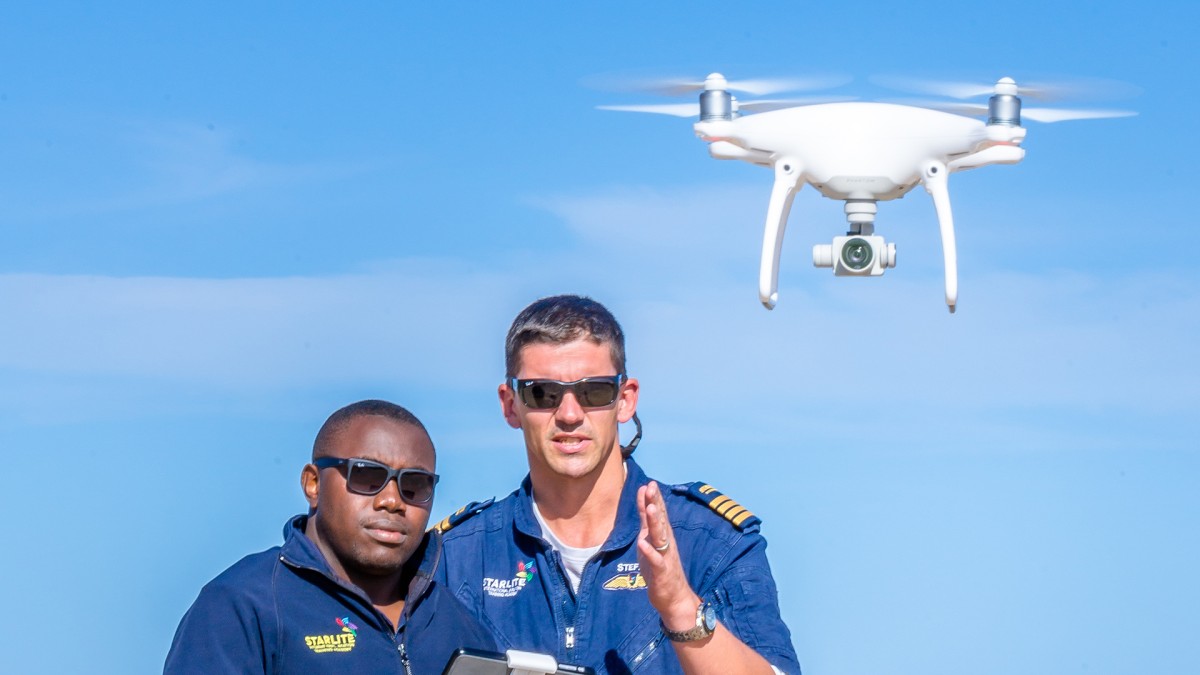
Starlite Aviation Training Academy has also appeared in the SACAA's published list of approved remote-pilot training organisations. The historical list identifies the academy for RPAS flight training and RPC multirotor VLOS training.
This makes it another provider worth contacting, particularly if you want to compare aviation training organisations rather than selecting a school based on price alone.
However, approval listings can change. Confirm the academy's current RPC course availability and approval status with the SACAA before enrolling. Request a written quotation showing the duration, aircraft category, practical training arrangements, assessment charges and any additional costs.
Website: Starlite Aviation
How much do drone pilot courses cost in South Africa?
The prices published by the providers above show that professional drone pilot training can cost tens of thousands of rands. Introductory courses cost less, but they should not be confused with the training required for a professional pilot certificate.
|
Training provider |
Published price |
Advertised duration or location |
|---|---|---|
|
The Academy of Aviation |
R44,998 including VAT |
3 weeks full-time or 7 weeks part-time; Honeydew |
|
Zefr Drones |
R21,950 |
Virginia Airport, Durban |
|
DroneLabs Academy |
R23,000 |
4–6 weeks |
|
Saphire Blue Drones |
R21,350 excluding VAT |
Nelspruit Airport |
|
ProWings Africa |
Request a quote |
Sandton and Hekpoort |
|
Omnisky Academy |
Request a quote |
Confirm current training arrangements |
|
Heli-X Cape Town |
Request a quote |
Confirm current training arrangements |
|
Starlite Aviation |
Request a quote |
Confirm current course availability |
These are prices published by the providers, not a standard national tariff. Fees and course packages can change, so request a current quotation before budgeting for training.
When comparing prices, ask whether the amount includes practical training, examinations, radiotelephony, the aviation medical, SACAA licensing charges, learning materials and reassessments. Also budget for travel and accommodation if you need to train outside your home province.
What are the requirements to become a drone pilot in South Africa?
For a professional drone pilot certificate, the SACAA lists requirements that include being at least 18 years old, having the necessary medical assessment, training through an approved organisation, passing the required practical assessment and radiotelephony examination, and meeting the English language proficiency requirement.
The full requirements depend on the applicable certificate and rating. Start with the SACAA's official Unmanned Aircraft Systems information and ask your chosen training provider to explain the requirements for your specific course.
Before enrolling, confirm the following:
- Your age and educational requirements for the course.
- Which aviation medical assessment you need.
- Whether radiotelephony training and examinations are included.
- Which drone category and rating you will train for.
- Whether the practical assessment and SACAA application fees are included.
- Whether the training organisation's approval covers the course being advertised.
The SACAA also operates an ATO verification portal where prospective students can check approved or declared training organisations. If a provider claims to be approved, request a copy of its certificate and training operations specification and verify them with the authority.
Is a drone pilot certificate enough to start earning money?
Not necessarily. This is one of the most important details to understand before paying for training.
A pilot certificate demonstrates that you have completed the relevant pilot training and assessments. Commercial drone operations can also require the appropriate operator authorisation, approved and registered equipment, and insurance.
For example, a business carrying out aerial photography, surveying or infrastructure inspections may operate under its own approved operator arrangements. A newly qualified pilot may be able to work under an existing operator rather than setting up an operation independently.
Before buying an expensive drone or assuming you can start accepting paid jobs immediately after passing your course, ask the training provider to explain what you will still need after receiving the RPC.
What jobs can you pursue after drone pilot training?
Drone skills are used in several industries, but the jobs available to you will depend on your qualifications, experience, equipment and the permissions required for each operation.
Aerial photography and videography: Drone pilots can capture footage for property marketing, film productions, tourism businesses and commercial projects.
Construction and infrastructure: Businesses may use drone imagery to document construction progress, inspect structures and support site monitoring.
Agriculture: Drone operations can support crop monitoring, land observation and other agricultural services. Specialised work may require additional training and equipment.
Land surveying and mapping: Drone imagery can contribute to mapping and survey projects, but professional surveying work may require appropriately qualified professionals and specific workflows.
Industrial inspections: Companies may use drones to inspect roofs, infrastructure and difficult-to-access areas. The type of operation and required authorisations depend on the work being performed.
A course does not guarantee a job. It is worth researching employers and service providers in your area before enrolling so you can see what qualifications and experience they actually request.
How to avoid drone training scams
The SACAA has warned prospective aviation students about fraudulent training advertisements and organisations falsely claiming to hold approvals. It advises students to request the provider's approved training organisation certificate and training operations specification, then verify the documents with the authority.
Be cautious if a provider promises guaranteed employment, pressures you to pay immediately, refuses to provide its approval details or cannot explain which certificate the course leads to.
You should also be wary of courses marketed as a complete professional qualification when they only cover introductory drone flying. Ask for the full syllabus, the practical assessment arrangements and a written list of what is included in the fee.
If drone training is not the right fit, you can also compare solar installation courses and forklift training centres in South Africa for other practical career pathways.
Final thoughts
If you want to become a professional drone pilot in South Africa, compare the course content and total cost before deciding where to study. Zefr Drones, DroneLabs Academy and Saphire Blue publish prices for their RPC training, while The Academy of Aviation advertises a more expensive package that includes several additional components.
Whichever provider you choose, verify its current SACAA approval and ask exactly what the fee covers. A well-chosen course should leave you clear about the qualification you are working towards, the assessments you must pass and what you will still need before accepting paid drone work.
Frequently Asked Questions
What's Your Reaction?
 Like
0
 Dislike
0
 Love
0
 Funny
0
 Wow
0
 Sad
0
 Angry
0

Your trusted hub for youth opportunities in South Africa. From learnerships and courses to universities and colleges, we make it simple to find the right path for your future.












Comments (0)